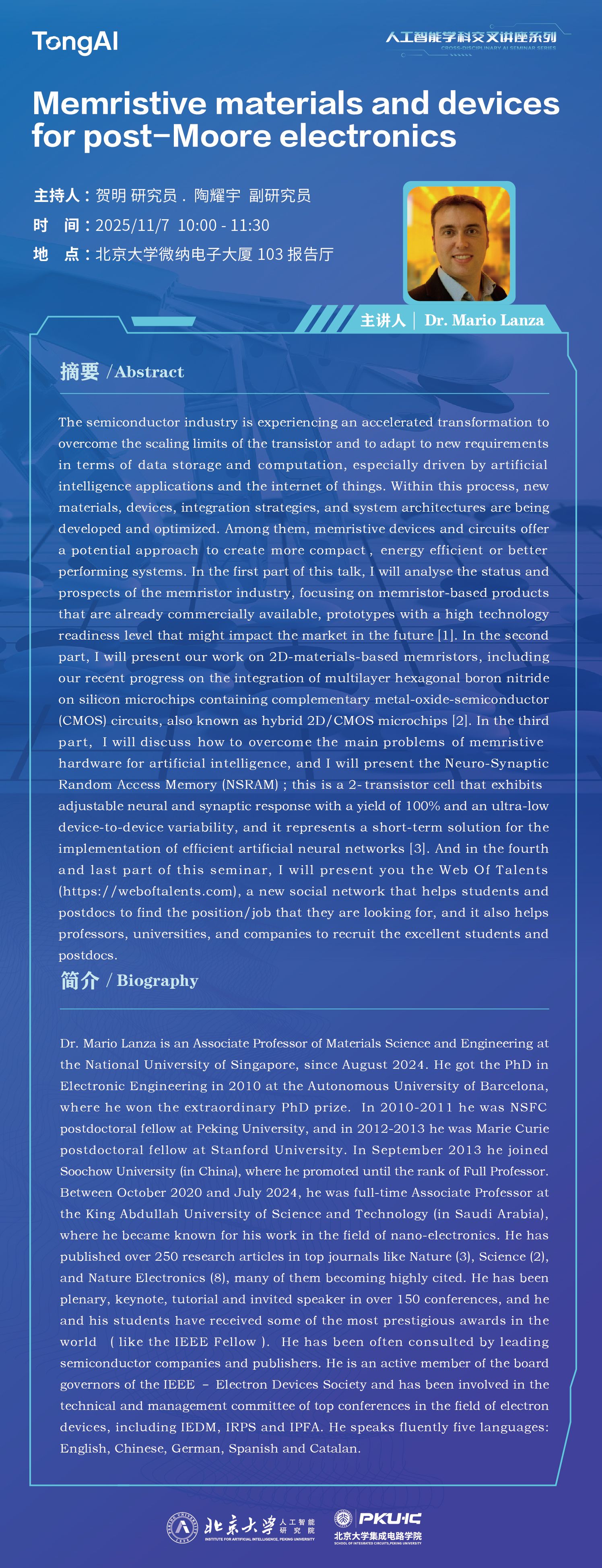
报 告 人:Dr. Mario Lanza
Associate Professor
National University of Singapore
主 持 人:贺明 研究员 北京大学集成电路学院
陶耀宇 副研究员 北京大学人工智能研究院
时 间:2025年11月7日 10:00-11:30
地 址:北京大学微纳电子大厦 103 报告厅
报告题目:
Memristive materials and devices for post-Moore electronics
报告摘要:
The semiconductor industry is experiencing an accelerated transformation to overcome the scaling limits of the transistor and to adapt to new requirements in terms of data storage and computation, especially driven by artificial intelligence applications and the internet of things. Within this process, new materials, devices, integration strategies, and system architectures are being developed and optimized. Among them, memristive devices and circuits offer a potential approach to create more compact, energy efficient or better performing systems. In the first part of this talk, I will analyse the status and prospects of the memristor industry, focusing on memristor-based products that are already commercially available, prototypes with a high technology readiness level that might impact the market in the future. In the second part, I will present our work on 2D-materials-based memristors, including our recent progress on the integration of multilayer hexagonal boron nitride on silicon microchips containing complementary metal-oxide-semiconductor (CMOS) circuits, also known as hybrid 2D/CMOS microchips. In the third part, I will discuss how to overcome the main problems of memristive hardware for artificial intelligence, and I will present the Neuro-Synaptic Random Access Memory (NSRAM); this is a 2-transistor cell that exhibits adjustable neural and synaptic response with a yield of 100% and an ultra-low device-to-device variability, and it represents a short-term solution for the implementation of efficient artificial neural networks. And in the fourth and last part of this seminar, I will present you the Web Of Talents (https://weboftalents.com), a new social network that helps students and postdocs to find the position/job that they are looking for, and it also helps professors, universities, and companies to recruit the excellent students and postdocs.
报告人简介:
Dr. Mario Lanza is an Associate Professor of Materials Science and Engineering at the National University of Singapore, since August 2024. He got the PhD in Electronic Engineering in 2010 at the Autonomous University of Barcelona, where he won the extraordinary PhD prize. In 2010-2011 he was NSFC postdoctoral fellow at Peking University, and in 2012-2013 he was Marie Curie postdoctoral fellow at Stanford University. In September 2013 he joined Soochow University (in China), where he promoted until the rank of Full Professor. Between October 2020 and July 2024, he was full-time Associate Professor at the King Abdullah University of Science and Technology (in Saudi Arabia), where he became known for his work in the field of nano-electronics. He has published over 250 research articles in top journals like Nature (3), Science (2), and Nature Electronics (8), many of them becoming highly cited. He has been plenary, keynote, tutorial and invited speaker in over 150 conferences, and he and his students have received some of the most prestigious awards in the world (like the IEEE Fellow). He has been often consulted by leading semiconductor companies and publishers. He is an active member of the board governors of the IEEE – Electron Devices Society and has been involved in the technical and management committee of top conferences in the field of electron devices, including IEDM, IRPS and IPFA. He speaks fluently five languages: English, Chinese, German, Spanish and Catalan.